
Restaurants are among the most energy-intensive commercial operations in any industry. A full-service restaurant uses roughly three to five times more energy per square foot than a typical office building, and that gap is even wider for high-volume operations running multiple kitchen stations, walk-in refrigeration, commercial dishwashers, and HVAC systems simultaneously.
For most restaurant owners, energy is the third-largest operating expense after food and labor. Yet it’s often the least actively managed. Bills arrive, payments go out, and the focus stays on the kitchen and the floor where the business is visibly happening.
That’s exactly why energy costs represent such a significant and recoverable opportunity for restaurants willing to look at them seriously.
The Restaurant Energy Profile: Where the Money Goes
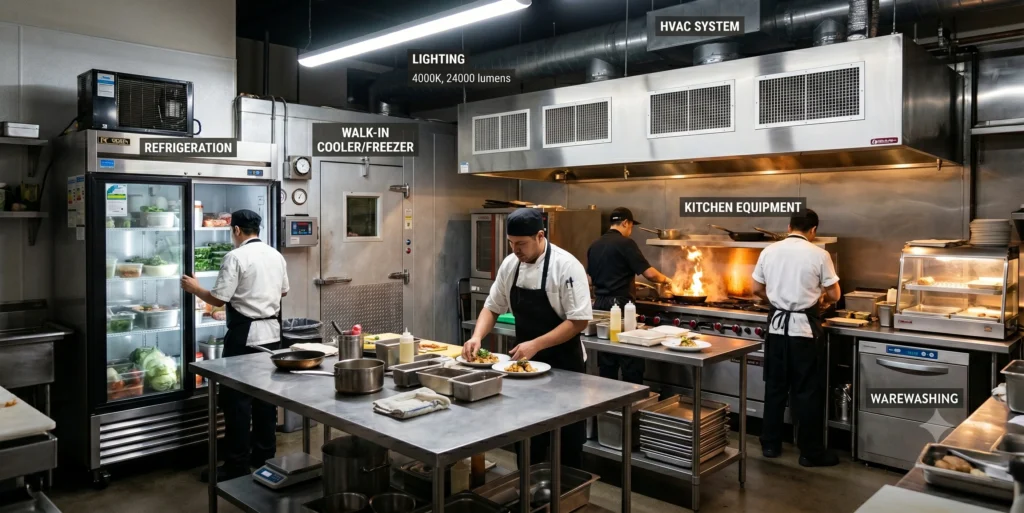
Before addressing solutions, it helps to understand where restaurant energy actually goes. The breakdown looks roughly like this for a typical full-service operation:
- Kitchen equipment (cooking, holding, warming): 35% to 40% of total energy use
- HVAC (dining area comfort, kitchen ventilation): 25% to 30%
- Refrigeration (walk-ins, reach-ins, display cases): 15% to 20%
- Lighting: 8% to 12%
- Water heating: 5% to 8%
- Other (dishwashing, POS systems, miscellaneous): remainder
This profile has two important implications. First, the kitchen is where the largest savings opportunity lives — it’s also where the most energy-intensive equipment runs. Second, both electricity and natural gas play significant roles in most restaurant operations, meaning both supply contracts deserve review.
8 Ways to Reduce Energy Costs in Your Restaurant
1. Review Both Your Electricity and Gas Supply Contracts
Most restaurant owners have never compared their energy supplier rates — and many don’t realize they can. In deregulated energy markets, restaurants have the right to choose both their electricity and natural gas supplier, with the local utility continuing to handle delivery regardless of which supplier sets the rate.
If your current energy contracts were signed more than 18 months ago and have never been reviewed, there’s a meaningful chance the market has moved and better rates now exist. For a restaurant spending $4,000 per month on combined electricity and gas, a 10% rate improvement translates to $4,800 per year — recovered with no changes to operations, equipment, or staff.
An independent energy cost analysis covers both electricity and gas. Upload your bills and get a clear comparison within 24 to 48 hours.
→ How to Compare Business Energy Suppliers and Find a Better Rate
→ How to Reduce Your Business Electricity Bill
→ How to Reduce Gas Costs for Your Business
2. Upgrade to ENERGY STAR-Rated Kitchen Equipment
Commercial kitchen equipment is the single largest energy consumer in most restaurants — and it’s also the category with the widest efficiency gap between older and modern alternatives.
ENERGY STAR-certified commercial kitchen equipment — fryers, ovens, steamers, dishwashers, refrigerators — uses significantly less energy than standard equivalents to produce the same cooking output. The efficiency gap varies by equipment type but commonly runs 20% to 40% for cooking equipment and 30% to 50% for commercial dishwashers.
Equipment replacement requires upfront investment, but the combination of energy savings, utility rebates (available through many state programs and utilities), and reduced maintenance costs typically delivers payback periods of two to four years on high-use items.
3. Install Demand-Controlled Kitchen Ventilation
Kitchen ventilation — the exhaust hoods above cooking equipment — is one of the largest hidden energy consumers in a restaurant. Traditional ventilation systems run at full capacity whenever the kitchen is open, regardless of actual cooking activity. During prep periods, slow service periods, or between meal rushes, that full-capacity ventilation is drawing conditioned air out of the building unnecessarily.
Demand-controlled kitchen ventilation (DCKV) systems use sensors to monitor cooking activity and adjust fan speed accordingly — running at full capacity during peak cooking and scaling back during lower-intensity periods. Studies consistently show DCKV systems reduce kitchen ventilation energy use by 30% to 50%, with corresponding reductions in HVAC load since less conditioned air is being exhausted.
For restaurants with high kitchen utilization, DCKV installation is one of the highest-ROI energy investments available.
4. Maintain Refrigeration Equipment Rigorously
Refrigeration runs 24 hours a day, seven days a week — meaning even small inefficiencies compound significantly over time. A walk-in cooler with a worn door gasket, dirty condenser coils, or a slightly underperforming compressor is consuming meaningfully more electricity than the same unit in good condition.
High-impact refrigeration maintenance practices include:
- Door gasket inspection and replacement — a damaged gasket allows cold air to escape continuously; replacement is inexpensive relative to the energy waste it prevents
- Condenser coil cleaning — dirty coils force the compressor to work harder; cleaning every three to six months restores efficiency
- Evaporator fan motor checks — failed or struggling fan motors increase compressor load
- Temperature verification — refrigeration units running colder than necessary consume more energy without food safety benefit; verify setpoints are correctly calibrated
For restaurants with walk-in coolers and freezers, a quarterly refrigeration maintenance program is a low-cost, high-return investment.
5. Optimize HVAC for the Restaurant Environment
Restaurant HVAC faces a unique challenge: it must simultaneously manage the heat generated by a commercial kitchen and maintain comfortable temperatures in the dining area — two environments with very different thermal loads.
Common HVAC inefficiencies in restaurant settings include:
- Oversized systems that cycle on and off frequently rather than running at steady state — this is less efficient and increases wear
- Kitchen and dining zone imbalances — inadequate separation between kitchen heat and dining area comfort forces the system to work harder
- Filters that aren’t changed frequently enough — restaurant environments load filters with grease and particulates faster than typical commercial settings, degrading airflow and efficiency
- Systems running at full capacity during closed hours — programmable thermostats that reduce heating and cooling overnight and during prep periods can deliver meaningful savings with no operational impact
6. Switch to LED Lighting Throughout
Lighting represents a smaller share of restaurant energy use than kitchen equipment or HVAC — but it’s also one of the easiest and most cost-effective improvements to make. LED fixtures use 50% to 75% less electricity than fluorescent or incandescent alternatives, last significantly longer, and produce less heat — which also slightly reduces the cooling load on HVAC.
For dining areas where ambiance matters, modern LED options offer full dimming capability and a wide range of color temperatures — from warm tones that complement food presentation to cooler options for fast-casual environments. LED retrofits for a typical restaurant can often be completed in a single day with minimal disruption.
7. Manage Hot Water Heating Efficiency
Water heating is a significant gas consumer in most restaurants — commercial dishwashers, hand-washing stations, food preparation, and cleaning all require consistent hot water throughout operating hours.
Practical steps for reducing water heating costs include:
- Insulating hot water pipes to reduce heat loss between the heater and point of use
- Installing low-flow pre-rinse spray valves on commercial dishwashing stations — these are inexpensive, easy to install, and can reduce hot water consumption by 50% at the dish station
- Reviewing water heater setpoint temperature — water heated beyond what’s required for food safety and sanitation wastes gas without operational benefit
- Scheduling dishwasher operation to consolidate loads and reduce the frequency of heating cycles
8. Conduct a Utility Bill Audit
Restaurant utility bills are complex — multiple meters, demand charges, rate classifications, and seasonal adjustments all create opportunities for billing errors that go undetected until someone looks. A utility bill audit reviews your electricity and gas bills systematically for overcharges, rate misclassifications, and anomalies.
For high-consumption operations like restaurants, audits frequently surface recoverable overcharges — costs that have been accumulating on bills for months without anyone noticing.
The Rate Side: Don’t Leave Money on the Table
All of the strategies above address the consumption side of restaurant energy costs — and they’re worth implementing. But they work best when combined with rate optimization.
A restaurant that has reduced its consumption through equipment upgrades and operational efficiency but is still paying an above-market supplier rate is capturing only half the available savings. The rate you pay per kilowatt-hour and per therm is independent of how much you consume — and in deregulated markets, it’s fully within your control to optimize.
For restaurants spending $3,000 to $6,000 per month on combined energy costs, the financial impact of a rate comparison is meaningful. An independent analysis costs nothing and takes less than five minutes to initiate.
→ Energy Cost Savings for Businesses: A Complete Guide
Get a Free Restaurant Energy Cost Analysis
SpendWizer provides free commercial energy cost analysis for restaurants and food service operations. Upload your electricity or gas bill — or both — and we’ll compare your current supplier rates against available options in your market within 24 to 48 hours.
No cost. No obligation. No pressure to switch.
If a better rate exists, you’ll see exactly what it is and what it would save your operation annually. If your current rates are already competitive, you’ll have that confirmed — and a clearer picture of your contracts going forward.
Upload your restaurant energy bill for a free analysis →
Frequently Asked Questions
How much can a restaurant realistically save on energy costs?
It varies based on size, current equipment, and contract status. Restaurants that have never compared supplier rates often find savings of 5% to 15% on their per-unit rate. When combined with equipment upgrades and operational efficiency improvements, total energy cost reductions of 20% to 30% over 12 months are achievable for many operations.
Should I focus on electricity or gas first?
Start with whichever represents the larger share of your monthly energy spend. For most full-service restaurants, electricity is the larger expense — but gas costs are significant enough to warrant review simultaneously. An independent analysis covers both in a single process.
Are there rebates available for energy-efficient restaurant equipment?
Yes — many utility companies and state energy programs offer rebates for ENERGY STAR-certified commercial kitchen equipment, LED lighting, and HVAC upgrades. Check with your local utility or state energy office for currently available programs before making equipment purchases.
Does switching energy suppliers affect my service?
No. The local utility continues to deliver electricity and gas to your restaurant regardless of which supplier you choose. Switching only affects the rate you pay — not reliability, delivery, or anything else about your service.
SpendWizer provides independent commercial energy cost analysis for businesses across the United States. Upload your bill and we’ll tell you whether a better rate exists — at no cost and with no obligation.