
There are two reasons a business energy bill climbs higher than it should. The first is paying too much per unit of energy — an outdated supplier rate, a poorly reviewed contract, or hidden terms that add cost invisibly. The second is using more energy than necessary to accomplish the same amount of work.
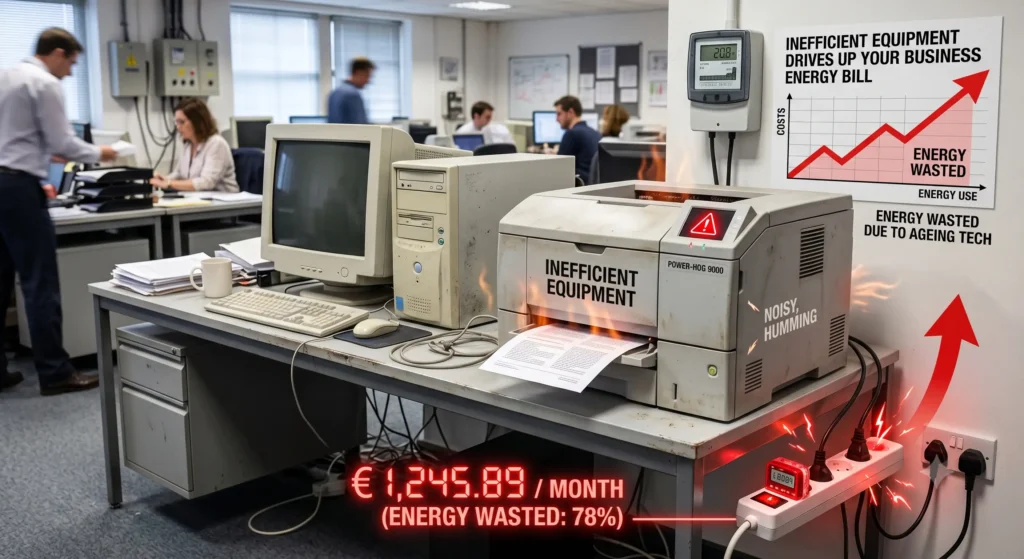
Inefficient equipment is the primary driver of the second problem. And for many businesses, it’s quietly adding hundreds or thousands of dollars to their monthly bill, without triggering any obvious alarm.
Here’s how it happens, what to look for, and what to do about it.
Why Equipment Efficiency Matters More Than Most Owners Realize
Every piece of equipment in a commercial operation converts energy into output, heat, light, motion, cooling, or computation. Efficient equipment does that conversion with minimal waste. Inefficient equipment does it with significantly more energy than necessary to produce the same result.
The efficiency gap between older and modern commercial equipment is often larger than business owners expect. A commercial HVAC unit from 2010 may use 30% to 40% more electricity than a current high-efficiency equivalent to produce the same cooling output. A fluorescent lighting system from the same era may use two to three times the electricity of a modern LED installation to deliver comparable illumination.
Multiply that gap across all the equipment in a facility, factor in operating hours, and the cumulative impact on the monthly electricity bill becomes substantial, often without any single piece of equipment being obviously broken or malfunctioning.
That’s what makes inefficient equipment such a persistent problem: it doesn’t announce itself. It just quietly draws more power than it should, month after month.
The Equipment Categories That Drive the Most Waste
Not all equipment has equal impact on energy consumption. The following categories account for the majority of energy waste in commercial operations and deserve the closest attention in any efficiency review.
HVAC Systems
Heating, ventilation, and air conditioning is the single largest energy consumer in most commercial buildings, typically accounting for 35% to 50% of total electricity use. HVAC systems degrade in efficiency over time as components wear, refrigerant levels shift, filters clog, and calibration drifts. A system that’s past its optimal service life may be working significantly harder than necessary to maintain the same temperature.
Key indicators of HVAC inefficiency include inconsistent temperatures across the facility, systems that run longer cycles than expected, and bills that climb in summer and winter without a corresponding change in usage patterns.
Regular maintenance, filter changes, coil cleaning, refrigerant checks, and annual professional servicing, preserves efficiency and extends equipment life. When a unit reaches the end of its serviceable life, replacement with a high-efficiency model delivers meaningful and immediate reductions in electricity consumption.
Lighting
Lighting is one of the most straightforward efficiency opportunities in any commercial setting — and one of the fastest to pay back. The technology gap between older fluorescent or metal halide fixtures and modern LED alternatives is significant:
- LED fixtures use 50% to 75% less electricity than fluorescent equivalents
- LED bulbs last 3 to 5 times longer, reducing replacement and maintenance costs
- LED lighting produces less heat, which also reduces the cooling load on HVAC systems
For businesses with large lit footprints [warehouses, retail stores, restaurants, office buildings] LED retrofit projects typically deliver payback periods of two to four years, with energy savings that continue for the life of the installation.
→ Energy Optimization for Warehouses: How to Cut Costs Without Cutting Operations
Refrigeration
For restaurants, grocery operations, convenience stores, and any business that stores perishable goods, refrigeration is a major and continuous energy consumer. Refrigeration systems run 24 hours a day, seven days a week, meaning even small efficiency losses compound significantly over time.
Common sources of refrigeration inefficiency include worn or damaged door seals that allow cold air to escape, dirty condenser coils that force the compressor to work harder, oversized units running below optimal capacity, and systems that haven’t been serviced in years.
A refrigeration unit operating with a compromised door seal can use 10% to 25% more electricity than the same unit in good condition. At commercial scale and continuous operation, that adds up quickly.
→ How to Reduce Energy Costs for Your Restaurant
Industrial Machinery and Motors
For manufacturing operations, distribution centers, and any business that runs motors, pumps, compressors, or conveyors, industrial equipment represents a major share of electricity consumption. Older motors without variable frequency drives (VFDs) run at full speed regardless of actual demand — drawing full power even when output requirements are lower.
VFDs allow motors to adjust speed to match actual load, reducing energy consumption during partial-load operation by 20% to 50% in many applications. For businesses with significant motor loads, VFD retrofits are among the highest-ROI efficiency investments available.
IT Equipment and Servers
Office environments and businesses with on-site server infrastructure often overlook IT equipment as an energy consumer. Servers, networking equipment, and workstations that run continuously [including outside business hours] draw meaningful amounts of power that accumulate over time.
Power management settings, server virtualization, and scheduled shutdowns for non-critical systems can reduce IT-related energy consumption without affecting operational capability.
How to Identify Inefficient Equipment in Your Operation
You don’t need sophisticated metering equipment to identify where energy waste is occurring.
Start with these practical steps:
Review equipment age. Any major system [HVAC, refrigeration, industrial motors] that is more than 10 years old is worth evaluating for efficiency. Technology has advanced significantly across all these categories in the past decade.
Look for equipment that runs longer or harder than expected. HVAC systems cycling more frequently than normal, refrigeration units that seem to run constantly, or motors that run warm are all signs of reduced efficiency.
Check maintenance records. Equipment that hasn’t been serviced regularly tends to degrade in efficiency faster than maintained equivalents. Identify any systems with gaps in their maintenance history.
Compare your consumption to industry benchmarks. Your utility or an independent energy analyst can help you understand whether your consumption per square foot is in line with comparable operations. Significant deviations often point to equipment inefficiency.
Request a utility bill audit. A professional audit evaluates your consumption patterns and identifies the specific areas where efficiency improvements would have the greatest impact.
→ What Is a Utility Bill Audit and How Can It Save Your Business Money?
Equipment Efficiency and Supplier Rate: Both Levers Matter
It’s worth being clear about what equipment efficiency improvements can and cannot do.
Operational efficiency reduces how much energy your business consumes. That’s valuable, but it has a ceiling. At some point, you’ve optimized schedules, upgraded lighting, serviced HVAC, and there’s limited additional consumption to eliminate.
The other lever [what you pay per unit of energy] has its own independent impact. A business that has optimized its consumption but is still paying an above-market supplier rate is leaving money on the table. Conversely, a business that has secured a competitive supplier rate but is running inefficient equipment is also overpaying — just through a different mechanism.
The businesses that achieve the most significant and lasting energy cost reductions address both sides: they reduce consumption through operational efficiency and equipment upgrades, and they ensure the rate they pay per unit reflects what’s currently available in the market.
→ How Outdated Energy Pricing Is Costing Your Business More Than You Think
→ How Hidden Energy Contract Terms Are Costing Businesses Thousands
The Bottom Line
Inefficient equipment is a silent cost driver — it doesn’t send alerts, it doesn’t trigger alarms, and it doesn’t appear as a line item on your bill. It simply draws more power than necessary, month after month, while the business assumes everything is running normally.
A systematic review of your major equipment categories — HVAC, lighting, refrigeration, motors, and IT infrastructure — is the starting point for identifying where efficiency improvements will have the greatest financial impact.
And once you’ve addressed consumption, make sure the rate you’re paying per unit is as competitive as your equipment. A free energy cost analysis tells you exactly where you stand — in 24 to 48 hours, with no obligation.
→ Upload your bill for a free energy cost analysis →
Related reading:
- Energy Cost Savings for Businesses: A Complete Guide
- What Is an Automatic Energy Contract Renewal and How Can It Cost Your Business?
SpendWizer provides independent commercial energy cost analysis for businesses across the United States. Upload your bill and we’ll tell you whether a better rate exists — at no cost and with no obligation.